
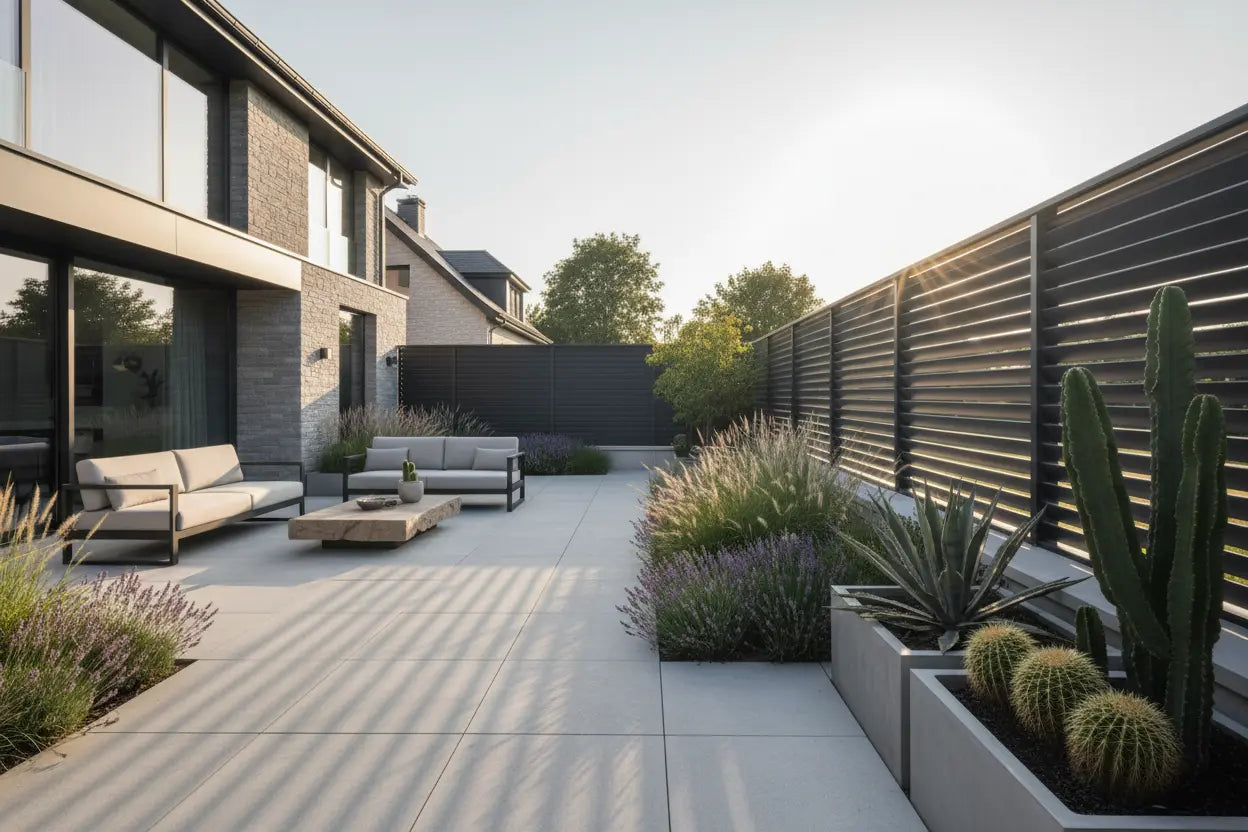
For years, homeowners had to choose between two extremes:
- Full privacy with a heavy boxed-in feeling
- Open fencing with little protection from neighbours
In 2026, modern fencing design is changing that balance completely.
Louvered and horizontal slat fencing systems are rapidly becoming one of Europe’s most requested exterior trends because they provide:
- Privacy
- Light flow
- Air circulation
- Modern architectural appearance
Without making gardens feel enclosed.
Why Traditional Solid Fencing Feels Outdated
Older solid-panel fences often create problems such as:
- Darker gardens
- Reduced airflow
- Wind pressure issues
- Smaller visual spaces
This is especially noticeable in compact urban gardens where natural light already becomes limited due to neighbouring properties.
Modern homeowners now want boundaries that feel lighter while still protecting privacy.
What is Louvered Fencing?
Louvered fencing uses angled slats designed to:
- Block direct sight lines
- Allow airflow
- Maintain partial light penetration
The result is a fence that feels visually open while still offering excellent privacy.
It is commonly used in:
- Modern residential gardens
- Pool areas
- Terrace screening
- Architectural landscaping
Why Horizontal Slat Fencing is Dominating 2026
Horizontal slat systems create cleaner visual lines and make outdoor spaces appear:
- Wider
- More modern
- More premium
This style has become extremely popular across:
- Belgium
- France
- The Netherlands
- Scandinavian-inspired architecture
Especially when paired with:
- Anthracite finishes
- Timber-effect coatings
- Minimalist landscaping
The Psychology Behind Modern Privacy Design
People no longer want outdoor spaces that feel defensive or closed off.
Modern fencing design focuses on:
- Comfort
- Visual openness
- Light retention
- Architectural integration
This is one reason why slatted fencing is outperforming traditional concrete and closed timber panels in new exterior projects.
Pros & Cons of Slat and Louvered Fencing
| Pros | Cons |
|---|---|
| Better airflow | Slightly less absolute privacy |
| Modern appearance | Premium systems cost more |
| Reduced boxed-in feeling | Installation precision matters |
| Improved wind resistance | |
| Better natural light |
Are Slatted Fences Still Private?
Yes — when designed correctly.
Modern systems use:
- Carefully calculated spacing
- Angled profiles
- Overlapping blade designs
This limits direct visibility while preserving openness.
Some premium systems even provide:
- Different visual appearances from each side
- Near full frontal privacy
- Better airflow than traditional panels
Wind Resistance Advantages
Solid fencing acts almost like a sail during storms.
Slatted systems reduce wind pressure by allowing controlled airflow through the fence structure.
Benefits include:
- Lower strain on posts
- Reduced movement
- Improved longevity
- Better storm performance
This has become increasingly important due to stronger seasonal storms across Europe.
Best Materials for Modern Slat Fencing
Galvanised Steel
- Extremely durable
- Minimal maintenance
- Slim profile capability
- Strong structural performance
Aluminium
- Lightweight
- Modern finish
- Corrosion resistant
Composite
- Timber-look appearance
- Reduced maintenance
Colour Trends for 2026
The most requested colours currently include:
- Anthracite RAL7016
- Grey RAL7024
- Black RAL9005
- Walnut timber effect
- Oak timber effect
Matte textured finishes are also becoming significantly more popular than gloss surfaces.
Final Thoughts
Modern privacy fencing is no longer about building a wall around your property.
The trend in 2026 is creating outdoor spaces that feel:
- Open
- Architectural
- Bright
- Comfortable
- Private without isolation
Louvered and slat fencing achieves that balance better than almost any traditional fencing system available today.
Share:
The Death of the 2-Year Stain: Top 5 Maintenance-Free Fencing Materials for 2026
Storm-Proof Your Property: How to Choose Fencing That Won’t Blow Down