
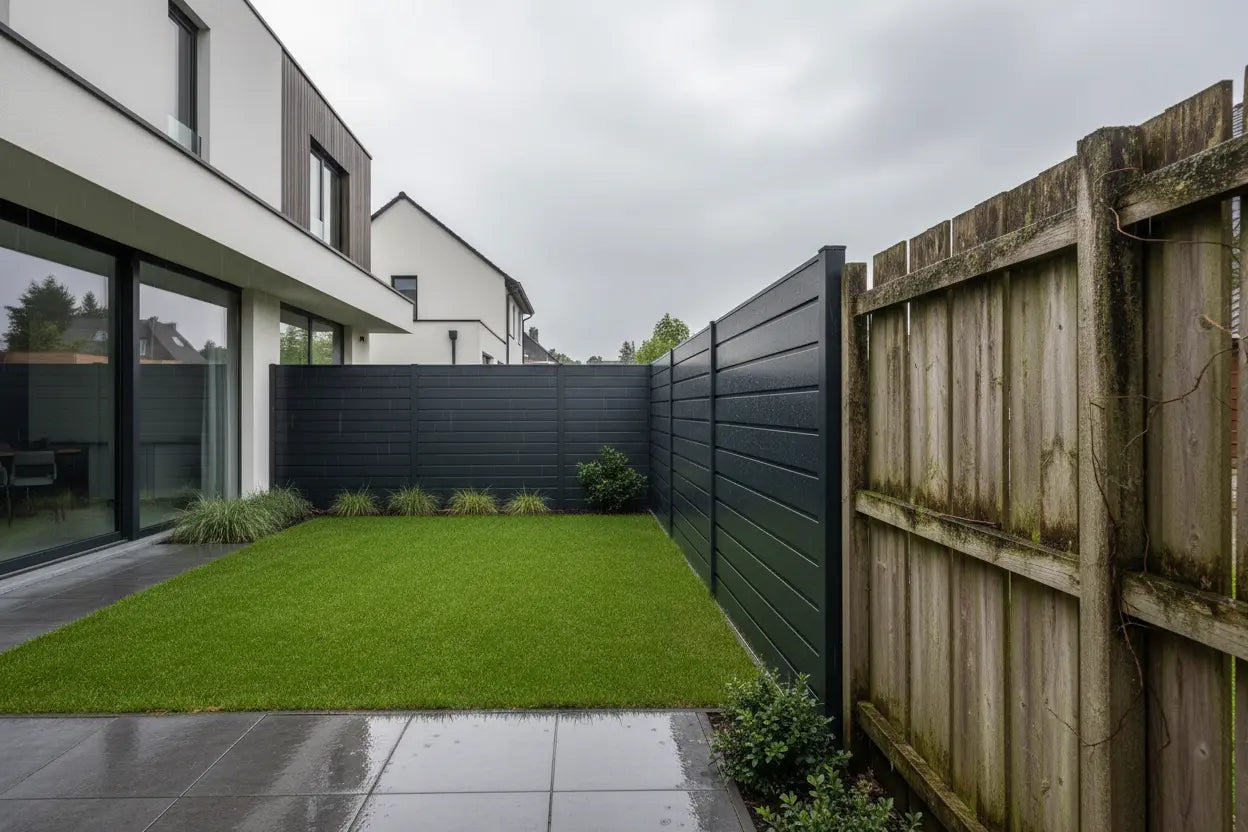
Every homeowner loves the look of a freshly installed timber fence. Few enjoy sanding, staining, repainting, and replacing warped boards every couple of years.
In 2026, the shift toward maintenance-free fencing is accelerating across Belgium and the rest of Europe. Rising labour costs, wetter winters, and higher expectations for long-term durability are pushing homeowners toward smarter alternatives.
If you are planning a new boundary this year, here are the top low-maintenance fencing materials worth considering.
Why Traditional Timber is Losing Popularity
Timber fencing still has its place, but many homeowners underestimate the long-term maintenance involved.
Typical issues include:
- Rot and moisture absorption
- Colour fading from UV exposure
- Algae and moss growth
- Warping and cracking
- Annual or biannual treatment costs
What initially appears cheaper often becomes more expensive over a 10–15 year period once maintenance, repairs, and replacements are included.
1. Galvanised Steel Fencing
Modern galvanised steel fencing has become one of the strongest alternatives to timber and aluminium.
Today’s premium systems use multi-layer protective coatings including:
- Zinc galvanisation
- Passivation layer
- Primer coating
- UV-resistant polymer finish
The result is a fence designed to withstand:
- Heavy rain
- Frost
- UV exposure
- Corrosion
- Impact damage
Unlike timber, steel does not require repainting or sealing.
Best For
- Full privacy gardens
- Windy areas
- Modern homes
- Long-term investment properties
Pros & Cons
| Pros | Cons |
|---|---|
| Extremely durable | Higher upfront cost than basic timber |
| Minimal maintenance | Professional installation recommended |
| Modern appearance | Heavier than aluminium |
| Strong privacy options | |
| 50+ year lifespan possible |
2. Aluminium Fencing
Aluminium remains popular for homeowners wanting a sleek architectural appearance.
It offers:
- Excellent corrosion resistance
- Lightweight construction
- Modern minimalist styling
- No rusting
However, not all aluminium fencing is equal. Lower-grade systems may feel less rigid than steel alternatives.
Best For
- Contemporary homes
- Coastal environments
- Decorative boundaries
Pros & Cons
| Pros | Cons |
|---|---|
| Rust-resistant | Often more expensive |
| Lightweight | Can feel less robust |
| Modern appearance | Premium systems can become costly |
| Low maintenance |
3. Composite Fencing
Composite fencing combines recycled plastics and wood fibres to create a timber-look finish without traditional timber maintenance.
It has grown rapidly in popularity due to its:
- Consistent colour
- Resistance to insects
- Reduced maintenance
- Modern appearance
Best For
- Homeowners wanting a timber appearance
- Modern landscaping projects
Pros & Cons
| Pros | Cons |
|---|---|
| No staining required | Can expand slightly in heat |
| Timber-like finish | Lower-quality boards may fade |
| Recycled material options | Often heavier than expected |
| Resistant to rot |
4. PVC / Vinyl Fencing
PVC fencing remains a budget-friendly maintenance-free option.
It performs well in certain applications but is often less premium in appearance compared to steel or aluminium systems.
Best For
- Budget-conscious projects
- Decorative fencing
Pros & Cons
| Pros | Cons |
|---|---|
| Affordable | Can become brittle over time |
| No painting needed | Less premium appearance |
| Easy to clean | May discolor with UV exposure |
| Lightweight |
5. Thermally Modified Wood
For homeowners who still prefer natural timber, thermally modified wood is becoming a strong compromise.
The treatment process improves:
- Stability
- Rot resistance
- Lifespan
It still requires some maintenance but significantly less than untreated softwood fencing.
Best For
- Natural architectural projects
- Sustainable landscaping
Pros & Cons
| Pros | Cons |
|---|---|
| Natural appearance | Still requires maintenance |
| Improved durability | More expensive than standard timber |
| Better dimensional stability | Limited lifespan compared to steel |
Lifetime Cost Comparison: Timber vs Maintenance-Free Fencing
Many homeowners focus only on installation cost. The smarter approach is calculating total ownership cost over 15–20 years.
| Material | Initial Cost | Maintenance Cost | Expected Lifespan |
|---|---|---|---|
| Timber | Lower | High | 8–15 years |
| PVC | Medium | Low | 15–20 years |
| Composite | Medium-High | Very Low | 20–30 years |
| Aluminium | High | Very Low | 30+ years |
| Galvanised Steel | High | Extremely Low | 50+ years |
Which Material is Best for 2026?
For most modern homeowners, the decision now comes down to:
- Appearance
- Long-term durability
- Maintenance reduction
- Weather resistance
Galvanised steel and premium composite systems are currently leading the market due to their balance of:
- Modern aesthetics
- Structural strength
- Long-term value
- Minimal upkeep
Final Thoughts
The era of repainting fences every few years is ending.
Modern fencing systems now offer:
- Long-term durability
- Premium design
- Better privacy
- Reduced maintenance costs
- Improved weather resistance
Choosing the right system is no longer just about appearance. It is about investing once and avoiding years of ongoing work and repairs.
Share:
Garden Privacy & Fencing Blog
Privacy Without the Darkness: Why Louvered and Slat Fencing are 2026’s Biggest Trends